Direct Answer
The SAGE test — short for the Self-Administered Gerocognitive Examination — is a free, four-page pen-and-paper screening test, developed at The Ohio State University Wexner Medical Center, that you complete on your own in about 10 to 15 minutes to help detect early signs of memory and thinking problems. You then take your answer sheet to a physician, who scores and interprets it; SAGE can flag changes that are worth a closer look, but it does not diagnose Alzheimer's disease or any other condition (The Ohio State University Wexner Medical Center).
- What Is the SAGE Test?Key Facts at a GlanceWhy the SAGE Test MattersWhat the SAGE Test MeasuresHow the SAGE Test Is Taken and ScoredCan You Take the SAGE Test Online?Is the SAGE Test a Test for Alzheimer's?Understanding SAGE ScoresHow SAGE Compares With Other Screening TestsWhen You Might Use SAGECan the SAGE Test Diagnose Dementia?What Happens NextTaking the Next StepFrequently asked questionsSources
What Is the SAGE Test?
SAGE is a brief cognitive screening instrument designed to identify mild cognitive impairment (MCI) from any cause and early dementia. Ohio State notes that its questions are deliberately more difficult than those on similar questionnaires such as the Mini-Mental State Examination, so that it can pick up very mild impairments (Ohio State University Wexner Medical Center).
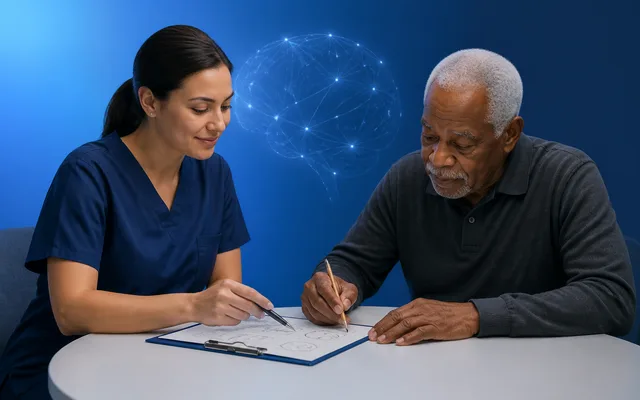
The word that sets it apart is self-administered. Most office screens are given by a clinician; with SAGE, you read the questions and write your own responses, so it can be completed at home, in a waiting room, or in a physician's office. There is no fee for individual clinical and noncommercial educational use.
SAGE is one of several brief screens used in cognitive testing. This page explains what the test is and how it is taken; for what the numbers mean, see our companion guide on how SAGE test scoring works.
Key Facts at a Glance
- Full name: Self-Administered Gerocognitive Examination, developed by Dr. Douglas Scharre and colleagues at Ohio State.
- Format: four pages, pen and paper, completed on your own in ink.
- Time: usually 10 to 15 minutes, with no time limit.
- Versions: four interchangeable forms — you only need to take one.
- Scoring: done by a physician; there is no self-scoring answer key.
- Purpose: screening for MCI and early dementia, not diagnosis.
- Where to get it: a free download from Ohio State, plus a licensed digital version.
Why the SAGE Test Matters
SAGE was developed to give people a low-barrier way to check in on cognition early. Ohio State points out that many people do not seek help for these symptoms until they have had them for several years — and that many causes of thinking loss are treatable, with treatment in some cases very effective when started as symptoms first begin (Ohio State University Wexner Medical Center).
That accessibility appears to make a real difference in practice. In a 2024 study of 300 primary care patients aged 65 to 89, providers who used SAGE documented new cognitive conditions or concerns in 9% of patients, compared with 1.5% among patients who did not take it — about six times as often (Scharre et al., Frontiers in Medicine, 2024). When SAGE was offered at 45 community events, 1,047 adults over 50 completed it, and cognitive impairment was identified in 28%, showing it can work with both small and large groups (Scharre et al., 2014).
What the SAGE Test Measures
Rather than testing a single skill, SAGE samples several areas of thinking that can change when cognition is affected. Across its questions, it assesses seven domains — orientation, language, memory, executive function, abstraction, calculations, and visuospatial abilities — for a maximum score of 22 points (Scharre et al., Alzheimer's Research & Therapy, 2017).
The form also includes background questions that are not scored: education, history of strokes or head injuries, family history of cognitive problems, and current symptoms such as changes in memory, balance, mood, personality, or everyday activities. Those answers give the physician context for reading the result (Scharre et al., 2017).
For a wider view of how SAGE compares with other tools, see our guide to the types of cognitive tests.
How the SAGE Test Is Taken and Scored
SAGE is genuinely self-administered: no examiner reads items aloud, and no training is needed to give it (Scharre et al., 2017). Ohio State's instructions for taking it are simple (Ohio State University Wexner Medical Center):
- Take one form. There are four versions and they are interchangeable, so it does not matter which one you use.
- Answer in ink, on your own. The test should be completed without help from anyone else.
- Keep clocks and calendars out of view while you work.
- Do your best if an item is unclear. Whoever gives the test does not answer questions about specific items.
- Take your time. Most people finish in 10 to 15 minutes, but there is no time limit.
- Bring the answer sheet to your doctor, who scores it and talks through the results with you.
Scoring is not a do-it-yourself step. Ohio State deliberately does not publish a self-scoring answer sheet because many questions have more than one correct answer, and it asks that SAGE be scored by your physician. On average the test takes about 13 minutes to complete and 30 to 60 seconds for a physician to score (Scharre et al., 2017).
Those instructions exist for a reason. A screen is only useful if it reflects how you think on an ordinary day, so looking up answers or rehearsing the questions beforehand would make the result meaningless. The four forms exist partly to reduce practice effects when someone takes the test more than once (Ohio State University Wexner Medical Center).
Can You Take the SAGE Test Online?
Yes, in two official ways — though neither replaces a physician's review.
The printable version. Ohio State offers the paper SAGE as a free download from its memory disorders website. Before downloading, you agree to terms of use that permit individual clinical, noncommercial educational, and noncommercial research use, and that state that the test cannot substitute for medical advice, diagnosis, or treatment (Ohio State University Wexner Medical Center). You print it, complete it in ink, and take it to your doctor.
The digital version. SAGE was licensed by Ohio State to BrainTest, which offers a tablet and mobile app version known in research as eSAGE. It uses the same questions as the paper test. In a validation study, eSAGE scores tracked the paper version closely, but people scored about one point lower on the digital version on average — and people with no prior smartphone or tablet experience scored lower still. The median time to finish was 17.5 minutes digitally versus 16 minutes on paper, including unscored background questions (Scharre et al., 2017). Because of that one-point gap, a physician compares paper and digital scores with care rather than treating them as interchangeable.
Be cautious with versions posted elsewhere. Ohio State's terms do not grant permission to modify the test or redistribute it, so copies, quizzes, or "instant score" pages on other sites are not the official instrument. For a broader look at whether a cognitive test taken online is reliable, see our guide.
Is the SAGE Test a Test for Alzheimer's?
Ohio State describes SAGE as a test to detect signs of Alzheimer's and dementia, and it is often searched that way. It is more precise to say SAGE screens for early cognitive impairment of any cause. Ohio State states plainly that SAGE does not diagnose any specific condition, and its results will not tell you whether you have Alzheimer's disease, mini-strokes, or any number of other disorders — though they can help your doctor decide whether further evaluation is needed (Ohio State University Wexner Medical Center). The developers note that more research is needed to know whether the digital version helps identify decline in specific conditions such as Alzheimer's disease or vascular dementia (Scharre et al., 2017).
That distinction matters because many things besides Alzheimer's can lower a cognitive screening result. The Alzheimer's Association lists depression, untreated sleep apnea, delirium, medication side effects, thyroid problems, certain vitamin deficiencies, and excessive alcohol use as common causes of dementia-like symptoms, many of which can be reversed with treatment (Alzheimer's Association).
Diagnosing Alzheimer's itself involves a broader workup. According to the National Institute on Aging, doctors may ask about overall health, medicines, and daily functioning; run tests of memory, problem solving, attention, counting, and language; order blood and urine tests to look for other causes; carry out a psychiatric evaluation; and use brain scans or spinal fluid tests to support a diagnosis or rule out other causes. Some doctors can now also order a blood test for beta-amyloid, a protein linked to Alzheimer's, though NIA notes blood test results alone should not be used to diagnose dementia (National Institute on Aging). A screen such as SAGE sits at the very start of that process.
Where SAGE does connect to Alzheimer's is in tracking change. In a study of 424 memory clinic patients tested repeatedly, SAGE detected a significant decline in people with MCI who progressed to Alzheimer's dementia at least six months earlier than the MMSE did, while scores stayed stable in people whose MCI did not progress (Scharre et al., Alzheimer's Research & Therapy, 2021). Those are group findings from a single clinic, not a prediction for any individual. For background on the disease itself, see our explainer on what Alzheimer's disease is.
Understanding SAGE Scores
SAGE produces a single total out of 22 points, and a physician reads that number alongside your history rather than as a simple pass or fail. In the original validation study, SAGE identified about 79% of people with cognitive impairment (sensitivity) while correctly classifying about 95% of those without it (specificity), and its scores correlated strongly with detailed neuropsychological testing (Scharre et al., 2010).
Because the four versions are interchangeable, SAGE can also be repeated to watch for change, which is often more informative than any one score in isolation. The score ranges used in research, the point breakdown by domain, and how a physician weighs age and education are covered in detail in our guide to how SAGE test scoring works.
How SAGE Compares With Other Screening Tests
SAGE is often discussed alongside clinician-administered screens such as the MoCA test and the MMSE, which are given and scored by a professional in the office. In the 2010 validation study, SAGE correlated more closely with a full neuropsychological battery than the MMSE did (0.84 versus 0.76), with 95% specificity and 79% sensitivity compared with 90% and 71% for the MMSE in the same participants (Scharre et al., 2010).
The main practical differences come down to who gives the test and how long it takes:
- SAGE — self-administered on paper or tablet, about 10 to 15 minutes, scored afterward by a physician.
- MoCA and MMSE — given one-on-one by a trained examiner during a visit.
- Mini-Cog — a very brief clinician-given screen designed for short appointments.
- SLUMS test — another clinician-administered office screen.
None of these is "the" test for dementia; a physician picks a tool based on the setting and the person, and may use more than one.
When You Might Use SAGE
Ohio State suggests SAGE if you are concerned about your own memory or thinking, or if family or friends are having memory or thinking problems. It also notes that some memory loss and slower recall are normal with age — SAGE is most useful when changes are worrying you or those around you (Ohio State University Wexner Medical Center).
It can also fit into routine care. The 2024 primary care study notes that an objective cognitive assessment, or information about cognition from the patient or someone who knows them, is required as part of the Medicare Annual Wellness Visit, and six of the seven providers who used SAGE in the study said they would recommend it to colleagues (Scharre et al., 2024). Our guide to cognitive screening at the Medicare Annual Wellness Visit explains how that works.
Can the SAGE Test Diagnose Dementia?
No. SAGE is a screening instrument, and no single test can determine whether someone is living with Alzheimer's or another dementia — clinicians combine cognitive assessments with medical history, physical and neurological exams, and sometimes brain imaging or lab work (Alzheimer's Association). A concerning result is a prompt for more discussion, not a conclusion.
What Happens Next
After you complete SAGE, your physician scores it and explains the result in the context of your overall health. If the score does not suggest a need for further evaluation, Ohio State recommends that your doctor keep the test on file as a baseline, so a future test can show whether anything has changed (Ohio State University Wexner Medical Center).
If the result is lower than expected, your doctor may order follow-up tests or refer you on. In the 2024 primary care study, follow-up after SAGE included referrals for neuroimaging, lab work, neurology or psychiatry consultations, social work, counseling, and financial or legal planning (Scharre et al., 2024). The National Institute on Aging notes that a primary care doctor may refer to specialists such as geriatricians, neurologists, or neuropsychologists, or to a memory clinic (National Institute on Aging). Our guide to what happens after a low cognitive screening score walks through that process. Either way, the aim is clarity and an informed next step rather than alarm.
Taking the Next Step
To understand what a SAGE result means once it has been scored, read our guide to how SAGE test scoring works.
To complement a paper screen with a structured check-in you can do from home and share with your doctor, learn how Orena's clinically validated at-home test works.
Frequently asked questions
What is the SAGE test?
Is the SAGE test a test for Alzheimer's?
Can I take the SAGE test online?
How long does the SAGE test take?
Can I score the SAGE test myself?
Is the SAGE test the same as an FDA-cleared at-home cognitive test?
Sources
- SAGE — Memory Disorders — The Ohio State University Wexner Medical Center, 2024
- Self-administered Gerocognitive Examination (SAGE): A Brief Cognitive Assessment Instrument for Mild Cognitive Impairment (MCI) and Early Dementia — Alzheimer Disease and Associated Disorders, 2010
- Digitally translated Self-Administered Gerocognitive Examination (eSAGE): relationship with its validated paper version, neuropsychological evaluations, and clinical assessments — Alzheimer's Research & Therapy, 2017
- Self-administered gerocognitive examination (SAGE) aids early detection of cognitive impairment at primary care provider visits — Frontiers in Medicine, 2024
- Medical Tests for Diagnosing Alzheimer's — Alzheimer's Association, 2024
- Self-Administered Gerocognitive Examination: longitudinal cohort testing for the early detection of dementia conversion — Alzheimer's Research & Therapy, 2021
- Community Cognitive Screening Using the Self-Administered Gerocognitive Examination (SAGE) — The Journal of Neuropsychiatry and Clinical Neurosciences, 2014
- How Is Alzheimer's Disease Diagnosed? — National Institute on Aging, 2024
Medical disclaimer. This article is for general educational purposes and is not a substitute for professional medical or insurance advice. Orena does not diagnose Alzheimer’s or dementia from a test alone. Always consult your doctor about your specific situation.