Direct Answer
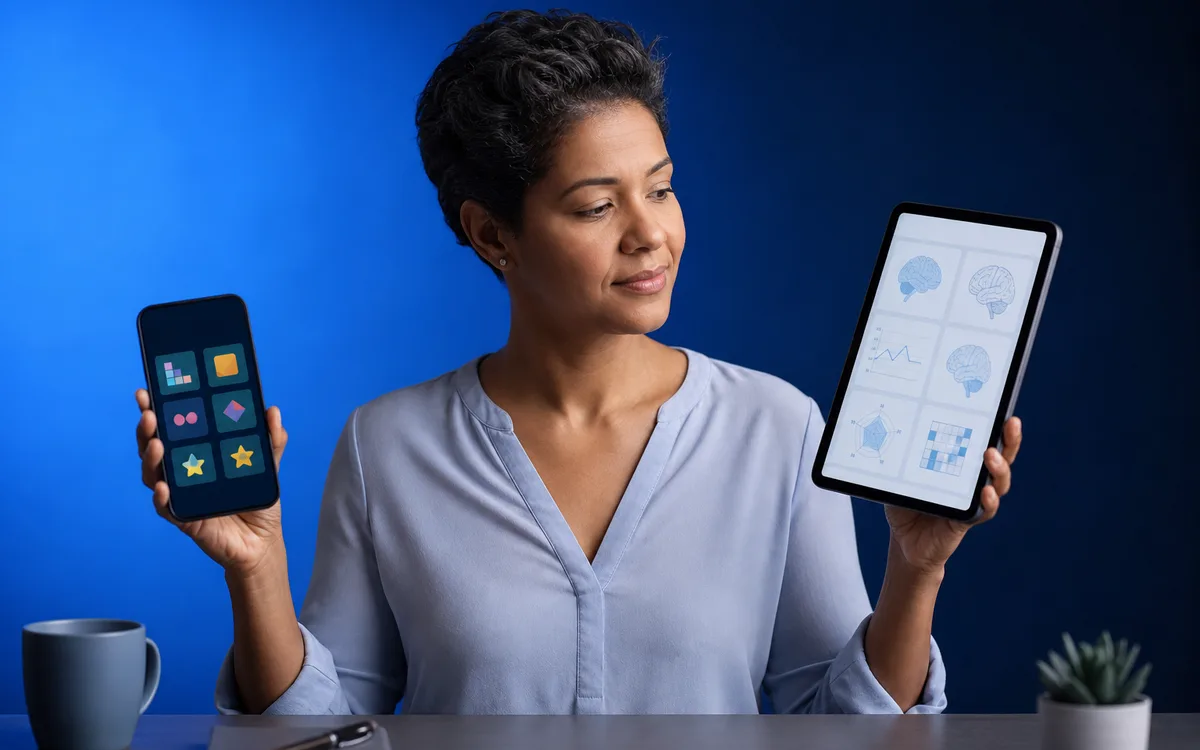
A free cognitive test online is usually a quick, unvalidated quiz meant for general interest, while an FDA-cleared cognitive test is a regulated medical device shown to meet federal standards for safety and performance. Free tools can be a casual starting point, but they are not designed to screen or track cognition reliably, and neither type replaces a clinician's evaluation. If you want structured, repeatable results, an FDA-cleared at-home test offers more rigor than a free quiz.
Why the Difference Matters
When you search for a "free cognitive test online," the results range widely — from lighthearted brain-age quizzes to serious, regulated screening tools. They can look almost identical on a screen, but what stands behind them is very different. One may have no published evidence at all; another may have passed a federal review of its accuracy and safety.
That difference matters because cognition is personal and consequential. A misleading result from an unvalidated quiz can create needless worry or, just as unhelpfully, false reassurance. Understanding how these tools are built and reviewed helps you decide which results are worth acting on and which are closer to entertainment.
Key Differences at a Glance
- Regulation: FDA-cleared tests are reviewed by the U.S. Food and Drug Administration as medical devices; free online quizzes typically are not.
- Evidence: Cleared tests must demonstrate they perform comparably to an existing, legally marketed device; free quizzes often have no published validation.
- Purpose: Cleared tools are designed for screening and monitoring; most free quizzes are built for engagement or general education.
- Consistency: Regulated tests use standardized administration and scoring; free quizzes vary widely in quality and repeatability.
- Interpretation: Both are screening tools, not diagnoses, and results should be reviewed with a clinician (Alzheimer's Association).
What "FDA-Cleared" Actually Means
"FDA-cleared" is a specific regulatory status, not a marketing slogan. Many cognitive-testing devices reach the market through the FDA's premarket notification, or 510(k), pathway, though some lower-risk tools are exempt from that step and are not "cleared" in this sense. To be cleared, a manufacturer must show the FDA that the device is "substantially equivalent" — at least as safe and effective as a legally marketed comparison device — before it can be sold (U.S. Food and Drug Administration).
Clearance is not the same as FDA "approval," a stricter pathway reserved for higher-risk devices, and it does not mean the agency guarantees any individual result. What it does signal is that the tool has passed an independent federal review of its safety and performance — a bar that free online quizzes generally never face. If you want to dig into that process, see our guide to what makes a cognitive test FDA-cleared.
What Free Online Cognitive Tests Can — and Can't — Do
Free online cognitive tests are easy to find and take only a few minutes, which makes them appealing as a first look. Used lightly, they can spark useful reflection about memory or focus and prompt a conversation with your doctor.
Their limits are important, though. Many home and online screening tools lack scientific validation and can produce false-positive results, which is why leading experts caution against relying on them (Alzheimer's Association). They also vary in quality, rarely adjust for factors like age or education, and cannot see your full medical picture. Cognition is shaped by sleep, stress, medications, and mood, and no brief quiz can untangle those influences on its own.
When Each One Makes Sense
Both kinds of tools have a place, depending on your goal:
- A free quiz can be fine for casual curiosity or a nudge to pay attention, as long as you treat the result as informal.
- An FDA-cleared at-home test makes sense when you want repeatable, structured results you can track over time or bring to a clinician.
- An in-person evaluation is the right step when symptoms interfere with daily life or come on quickly.
If you are comparing at-home options, it helps to understand how accurate at-home cognitive tests are and what it means to take a cognitive test online before you lean on any single result. Routine screening of adults without symptoms is not currently recommended for or against, because the evidence is still limited; clinicians instead evaluate anyone whose history or symptoms raise concern (U.S. Preventive Services Task Force).
What Happens Next
Whatever tool you start with, screening is only a first step. A brief test — free or FDA-cleared — can flag whether a closer look is worthwhile, but it cannot diagnose a condition on its own (National Institute on Aging).
If a result concerns you, the practical path is to note what you are noticing, share it with your primary care provider, and bring any structured results with you. A clinician can combine cognitive testing with your medical history and, when needed, brain imaging or lab work to reach an accurate answer (National Institute on Aging). For a broader overview of screening from home, start with our guide to at-home cognitive testing.
Taking the Next Step
To see how regulated at-home tools compare on reliability, read our guide on how accurate at-home cognitive tests are.
If you would like structured results you can track over time and share with your doctor, see how Orena's at-home cognitive test works.
Frequently asked questions
Are free online cognitive tests accurate?
What does FDA-cleared mean for a cognitive test?
Is FDA-cleared the same as FDA-approved?
Can any cognitive test diagnose dementia?
Sources
- Premarket Notification 510(k) — U.S. Food and Drug Administration, 2024
- Medical Tests for Diagnosing Alzheimer's & Dementia — Alzheimer's Association, 2024
- Cognitive Impairment in Older Adults: Screening — U.S. Preventive Services Task Force, 2020
- Assessing Cognitive Impairment in Older Patients — National Institute on Aging, 2023
- How Is Alzheimer's Disease Diagnosed? — National Institute on Aging, 2024
Medical disclaimer. This article is for general educational purposes and is not a substitute for professional medical or insurance advice. Orena does not diagnose Alzheimer’s or dementia from a test alone. Always consult your doctor about your specific situation.